Guest experience begins in the lobby, not the guest room. The 8 AM coffee spill spreading across marble, the elevator mirror smudged by a thousand fingerprints, the overflowing trash bin in the conference foyer at 6 PM, every one of those moments belongs to someone on your operations team. And rarely is that someone your housekeeper.
Most full-service hotels run a strong housekeeping program for guest rooms. Far fewer have a defined, professionally managed plan for everything outside the guest room, the lobby, restaurants, restrooms, conference and banquet space, fitness center, pool deck, hallways, elevators, and exteriors. That operational gap is where guest reviews tank, brand inspections fail, and slip-and-fall liability claims start.
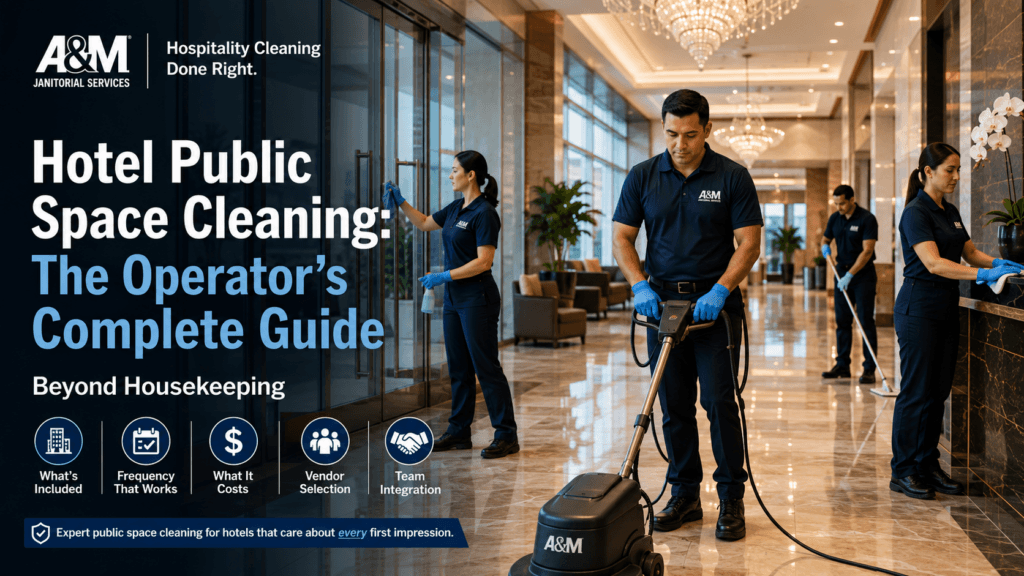
This guide walks through what hotel public space cleaning actually covers, how it differs from housekeeping, what frequency makes sense for each zone, what it costs, how to vet a vendor, and how to integrate a public space cleaning program with your in-house housekeeping team. It’s written for hotel general managers, directors of operations, facilities managers, and asset managers reviewing their property-level operating model, whether you run a single boutique property or a portfolio across multiple markets.
What Is Hotel Public Space Cleaning?
Hotel public space cleaning is the professional janitorial maintenance of every area of a hotel outside guest rooms, including lobbies, public restrooms, restaurants, conference and banquet rooms, fitness centers, pool decks, hallways, elevators, and exteriors. Unlike housekeeping, which handles guest room turnover, public space cleaning runs on a scheduled or continuous basis and focuses on high-traffic surfaces, brand-standard finishes, and guest-facing first impressions.
The work is closer in scope to commercial janitorial than to hotel housekeeping. It requires specialized equipment most housekeeping departments don’t operate, floor scrubbers, marble polishers, glass cleaning tools, pressure washers, and EPA-registered commercial disinfectants. It also requires different scheduling: most public space cleaning happens early morning before guests circulate, between meal periods, or after major events.
According to the American Hotel & Lodging Association (AHLA), labor costs across hotel operations remain a top-three operating expense, and public space coverage is one of the most common areas where in-house staffing falls short. Industry workforce data from the International Facility Management Association (IFMA) groups public-area cleaners separately from housekeeping in staffing benchmarks, a recognition that they are two distinct service lines.
Some operators refer to this work as common area cleaning, public area maintenance, front-of-house cleaning, or simply hotel janitorial services. The terminology varies; the scope is consistent.
Hotel Public Space Cleaning vs Housekeeping: The Critical Distinction
The single most common source of confusion in hotel operations is treating housekeeping and public space cleaning as the same function. They are not. They use different staff, different equipment, different schedules, and answer to different sections of the brand standard.
| Function | Housekeeping | Public Space Cleaning |
|---|---|---|
| Scope | Guest rooms, including in-room bathrooms and balconies | Everything outside guest rooms |
| Hours | Mid-morning through afternoon (during the turn) | Scheduled (off-peak) or continuous |
| Staffing | In-house, hotel-employed | Contracted vendor or hybrid |
| Tools | Cleaning carts, linens, room amenities, mini-supplies | Floor scrubbers, marble polishers, glass equipment, pressure washers |
| Brand standard | Brand-mandated room standards | Brand-mandated public area standards |
| Guest interaction | High (direct in-room contact) | Low (operates in the background) |
Most full-service and upscale select-service hotels need both, working in coordination. The hybrid model in-house housekeeping for guest rooms paired with a contracted public space cleaning vendor, is increasingly common because each function requires specialized capabilities that rarely live in one team.
Trying to have one team do both usually breaks down in one of two directions. Either housekeepers get pulled out of guest rooms to chase public-area calls (slowing the turn and tanking occupancy productivity), or the public spaces get neglected because the housekeeping department isn’t trained or equipped for marble polishing, pressure washing, or commercial floor care.
The cleaner distinction is also useful for understanding the difference between custodial and janitorial cleaning, both relate to public space cleaning, but with different scheduling and scope assumptions.
What’s Included: Zone by Zone
A complete hotel public space cleaning program covers seven distinct zones. Each has its own scope, frequency requirements, equipment needs, and brand standard touchpoints.
Lobby & Reception
The lobby is where guest experience begins and where brand impression is most fragile. A scuff on the marble, a fingerprint on the brass, or a water mark on the glass entrance reads to guests as a property problem, even if everything upstairs is immaculate.
Lobby cleaning covers:
- Marble, stone, terrazzo, and hardwood floor maintenance, spot cleaning, polishing, periodic deep restoration
- Glass entrance doors, partitions, and atrium glass (interior and exterior surfaces)
- High-touch surfaces: check-in desk, elevator call buttons, handrails, door handles, public phones
- Soft seating, area rugs, and decorative pieces
- Brass railings, signage, and metal fixture care
- Light fixture dusting and bulb monitoring
For properties with marble or stone lobbies, ongoing professional floor care is essential. Standard janitorial cleaning isn’t enough, marble requires diamond polishing, sealing, and specialized chemistry to maintain the reflective finish brands like Marriott Luxury and Hilton Curio Collection inspect for. A&M’s tile and grout cleaning and commercial floor cleaning programs are designed for exactly this kind of high-finish, high-traffic surface.
Public Restrooms
Public restrooms see traffic that residential bathrooms never approach. A lobby restroom in a 300-room hotel may receive 1,000+ uses per day during peak season. The cleaning protocol has to match.
Public restroom cleaning includes:
- Hourly inspection and restocking cycles during peak operating hours
- Disinfection of all high-touch surfaces using EPA-registered, hospital-grade products
- Floor care including grout sealing and odor management
- Touchless dispenser maintenance and supply management
- Mirror, partition, and fixture polish
- ATP (adenosine triphosphate) testing to verify cleaning effectiveness against an objective standard
ATP testing has become a brand standard expectation, particularly for Hilton CleanStay and Marriott Commitment to Clean compliance. It measures the actual biological residue on a surface after cleaning, giving operators data instead of visual inspection alone.
For a detailed task-level reference, see A&M’s public restroom cleaning checklist.
Hotel Restaurants, Bars & Food Outlets
Hotel restaurants present a different cleaning challenge than standalone restaurants because they operate alongside other public spaces and share staff coordination with banquet and room service operations. Front-of-house cleaning here has to coordinate with kitchen sanitation without crossing into hot-zone territory that belongs to food safety teams.
Public space cleaning in F&B outlets covers:
- Dining floor maintenance (spot and full cleaning between meal periods)
- Bar-area floor care, including immediate response for spills
- High-touch surface disinfection (bar tops, server stations, host stand)
- Glass cleaning on partitions and windows
- Coordination with kitchen/F&B teams on hot-zone boundaries
The same vendor often handles restaurant cleaning services at hotels and at standalone properties, which is useful for operators running mixed-asset portfolios.
Conference, Banquet & Meeting Spaces
Conference and banquet cleaning is event-driven, not schedule-driven. The cleaning window is often 30–60 minutes between sessions, sometimes less. The work has to be fast, complete, and invisible to the incoming group.
Coverage includes:
- Between-event turnover (chair reset, table clear, floor pass, trash management)
- AV equipment dusting and care
- Glass dividers, mirror panels, and atrium connections
- Pre-event deep clean before major bookings
- Post-event reset and deep clean after large functions
Properties with active convention and banquet programs need a vendor that can scale up coverage for major events and dial back during slow weeks.
Fitness Center & Pool Deck
The fitness center and pool area carry their own cleaning protocols because of equipment density, moisture, and the higher disease transmission risk of shared-surface cardio and weight equipment.
Coverage typically includes:
- Equipment surface disinfection following manufacturer protocols (some equipment is sensitive to certain chemicals)
- Mirror and glass care throughout the fitness space
- Locker room maintenance (overlaps with public restroom protocols)
- Pool deck spot cleaning and tile care
- Drain inspection and surrounding tile/grout cleaning
- Towel station restocking (where applicable)
Pool deck cleaning is specifically about deck surfaces and surrounding tile, not pool water chemistry, which belongs to the engineering or pool services team.
Hallways, Elevators & Vertical Transport
Hallways are where carpet replacement budgets either stretch to seven years or get blown in three. The difference is cleaning frequency and method.
Hallway and elevator coverage:
- Carpet vacuuming on a scheduled rotation
- Spot extraction for stains
- Periodic deep extraction (every 6–12 months depending on traffic)
- Elevator interior care: mirrors, walls, button panels, floor
- Stairwell cleaning (often neglected, often inspected)
- Hallway signage, baseboard, and wall maintenance
Hotel Exteriors, Entrances & Valet Areas
The exterior is the first physical surface a guest touches when they arrive. Smudged entrance glass and a stained valet pad shape the entire arrival experience before the guest gets to the front desk.
Exterior cleaning includes:
- Entry door glass (interior and exterior, twice daily during peak)
- Pressure washing of entry pavers, valet pads, smoking areas, and walkways
- Awning and signage cleaning
- Exterior light fixture maintenance
- Trash receptacle care
- Seasonal: leaf removal, ice management coordination
A&M handles entry-area exteriors through its pressure washing services and commercial window cleaning programs.
How Often Should Each Area Be Cleaned?
Frequency depends on traffic volume, hotel class, brand standard requirements, and event load. Here’s a working baseline matrix most full-service properties can use:
| Zone | Continuous | Daily | Weekly | Monthly |
|---|---|---|---|---|
| Lobby floors | Spot response | Full clean | Polish/buff | Deep restoration |
| Public restrooms | Hourly inspection | Full clean | Deep grout | Deep sanitation |
| F&B floors | Spot response | Full clean | Grout/edge work | Deep extraction |
| Conference (when used) | Per-event turnover | — | Deep clean | Quarterly restoration |
| Fitness center | Spot response | Full clean | Deep equipment clean | Floor restoration |
| Hallways | — | Vacuum | Spot carpet care | Deep extraction |
| Exteriors | — | Spot response | Pressure wash | Detail clean |
Brand programs prescribe minimum frequencies that often exceed this baseline. Marriott’s Commitment to Clean program, Hilton CleanStay, IHG Way of Clean, and Hyatt Global Care & Cleanliness all specify public-area disinfection cadence and high-touch surface protocols.
For a printable task-level reference covering the full hotel cleaning scope, see A&M’s complete hotel cleaning checklist.
How It Integrates with Your Housekeeping Team
The hybrid model, outsourced public space cleaning paired with in-house housekeeping, is the operational arrangement most full-service hotels arrive at. Here’s how the integration actually works in practice.
Roles are clean:
- Housekeeping owns guest rooms, including the bathrooms and balconies inside the room
- Public space cleaning owns everything outside the guest room
Communication happens at three touchpoints daily:
- Morning briefing: public space lead and head housekeeper align on the day’s banquet schedule, conference setups, VIP arrivals
- Incident escalation: both teams know the protocol for spills, guest complaints, and unexpected issues
- Shared SOPs: public restroom standards are documented once and enforced by both teams when they overlap
Brand standard alignment matters here. AAA Diamond inspections and brand-level inspections don’t distinguish between which team cleaned what, they grade the property as a whole. A vendor that knows your brand’s inspection criteria saves the GM from translating between two teams.
The economic case for the hybrid model is usually simple: a housekeeper getting pulled out of a room to handle a lobby spill is a 15-minute interruption that delays the turn and pushes back check-in readiness. A public space cleaning team handles the same spill in the background without disrupting room productivity.
Brand Standards & Public Space Cleaning
Major brand programs and third-party rating systems all specify public space cleanliness requirements separately from guest room standards.
AAA Diamond Inspection evaluates public-area cleanliness as one of several distinct criteria. Inspectors check lobby finishes, public restroom maintenance, elevator condition, hallway carpet, and exterior presentation as separately scored items. A clean guest room can’t compensate for a Three Diamond-level public space presentation at a Four Diamond property.
Forbes Travel Guide standards are stricter still. Their public-area touchpoint inspections include things like signs of recent cleaning (no visible dust on horizontal surfaces above eye level), maintained brass finishes, and intact grout lines in public restrooms.
Major brand cleaning programs:
- Marriott Commitment to Clean: public area disinfection cadence, high-touch surface protocols, EPA disinfectant requirements
- Hilton CleanStay: partnership with Lysol Pro Solutions, ATP testing for verification, specific public space frequencies
- IHG Way of Clean: five-step protocol with specific guidance for public spaces
- Hyatt Global Care & Cleanliness: accredited training and audit protocols for public-facing teams
Audit preparation is where a specialized vendor adds the most value. A cleaning team that has worked under multiple brand programs knows what the inspectors will check, in what order, and how to prepare the property in the 48 hours before an inspection visit.
What Does Hotel Public Space Cleaning Cost?
Pricing depends on hotel size, scope of work, frequency, complexity, and regional labor market. There are three common pricing models:
Per square foot per cleaning: most common for scheduled cleaning programs. Rates vary by region and finish type (marble lobbies cost more per square foot than basic commercial tile).
Per hour with scope of work: used for variable-coverage contracts where banquet, event, and conference work fluctuates significantly month to month.
Monthly contract with defined SOW: fixed monthly rate for a defined scope. Most operators land here once they understand their actual usage pattern.
Cost ranges scale with hotel class:
- Limited service / select service: lower end of the range, simpler scope, basic finishes
- Full service: mid-range, includes F&B and conference coverage
- Upscale and luxury: higher end, specialty surfaces (marble, brass, atrium glass), Forbes-grade standards
- Resort properties: broadest scope, often with significant exterior and pool deck coverage
The in-house vs outsourced math usually favors outsourcing past a certain property size. A full-time public-space staff member’s loaded cost (wages + benefits + workers’ comp + supervision + training + turnover replacement) typically runs 1.3–1.5x the headline wage. For most hotels above 100 rooms, a vendor contract is competitive on cost and superior on flexibility.
For broader commercial cleaning cost context, see A&M’s commercial cleaning pricing explained.
How to Choose a Hotel Public Space Cleaning Vendor
The vendor selection process for hospitality is different from general commercial cleaning because the operational sensitivities are different. Here’s a 10-question checklist that surfaces the right information.
- Do you specialize in hospitality? General commercial cleaners can work in hotels but won’t know brand standards, guest interaction protocols, or banquet turnover pace.
- How many hotel clients do you currently service? Ask for specifics on size, class, and brand.
- What brand standards have your teams worked under? AAA, Forbes, Marriott Commitment to Clean, Hilton CleanStay, IHG Way of Clean, Hyatt Global Care?
- What does your insurance and bonding look like? Minimum: general liability, workers’ comp, janitorial bonding. Request the COI before signing.
- How are background checks handled? Public-area staff have access to guest-facing zones and should pass standard background screening.
- What’s your supervisor-to-cleaner ratio? Quality control depends on supervision presence. Ratios above 1:15 often indicate thin oversight.
- What’s your escalation protocol for incidents? Spills, guest complaints, after-hours issues — who responds and how fast?
- How is performance measured and reported? Monthly KPI reporting, inspection scores, ATP testing data — not just hours billed.
- What’s the onboarding timeline? 30 days is reasonable for a full-service property; longer suggests a vendor that’s stretched thin.
- Can you handle our peak periods? Banquets, conventions, holidays — flexibility matters more than steady-state capacity.
Red flags to watch for: vendors who pitch themselves as housekeeping replacements (different service), pricing significantly below market (almost always means wage shortcuts or undertrained teams), and any vendor that can’t name brand standards they’ve worked under.
Frequently Asked Questions
What does a hotel cleaning service consist of?
A hotel cleaning service covers professional janitorial maintenance of all public-facing areas: lobby, public restrooms, restaurants and bars, conference and banquet rooms, fitness center, pool deck, hallways, elevators, and exteriors. It includes floor care, glass cleaning, high-touch surface disinfection, restroom maintenance, and event turnover. It does not include guest room cleaning, that’s housekeeping.
What’s the difference between hotel housekeeping and hotel cleaning?
Housekeeping cleans guest rooms during the daily turn. Hotel public space cleaning maintains everything outside guest rooms. They use different staff, different equipment, and different scheduling. Most full-service hotels run both as separate functions.
Do cleaning companies clean guest rooms?
Generally no. Guest room cleaning is housekeeping, which is almost always staffed in-house by the hotel because it involves direct guest contact, room amenity restocking, and brand-specific room presentation standards. Public space cleaning vendors handle everything else.
What is hotel public area cleaning called in the industry?
Common terms include public space cleaning, public area cleaning, common area cleaning, front-of-house cleaning, and hotel janitorial services. They all refer to the same scope.
Do hotels outsource public space cleaning?
Yes, increasingly so. Outsourcing the public space program while keeping housekeeping in-house is the most common hybrid model in full-service and upscale select-service properties.
How much does hotel public space cleaning cost per month?
Monthly cost depends on property size, scope, frequency, and finishes. Limited-service properties might run a fraction of what a full-service property with marble lobbies and active banquet space pays. The most reliable comparison is a per-square-foot or per-hour benchmark, requested via formal RFP.
How do hotel cleaning companies work with in-house housekeeping?
Coordination happens at three points daily: morning briefing on the day’s events and VIP arrivals, incident escalation for spills and complaints, and shared SOPs for overlap zones like the area immediately outside guest room doors.
Can one vendor cover all of our public spaces?
Yes, and it’s preferred. Single-vendor coverage simplifies brand standard alignment, reporting, and accountability. Splitting public space cleaning across multiple specialized vendors usually creates more management overhead than it saves.
Why A&M for Hotel Public Space Cleaning
A&M Janitorial Services provides hospitality-specialized public space cleaning programs for hotels across nine markets: Seattle, Bellevue, Portland, Los Angeles, San Diego, Phoenix, Scottsdale, Miami, and Denver. The teams are trained on AAA Diamond and major brand cleanliness standards, fully bonded and insured, and background-checked.
Coverage runs single-vendor across every public space zone, lobby, F&B, conference, restrooms, fitness, pool deck, hallways, and exteriors, under one scope of work and one accountability structure. The model is designed to complement your in-house housekeeping team, not replace it.
→ Request a custom scope-of-work proposal for your property
Conclusion
Public space cleaning isn’t an extra line item bolted onto a hotel operating budget. It’s the half of hotel cleaning your housekeeping team can’t cover, different scope, different equipment, different schedule, different brand standard requirements. Treating it as a distinct function (rather than something to squeeze out of an already-stretched housekeeping staff) is what separates properties that hit their brand inspection scores from properties that scramble in the 48 hours before AAA shows up.
For most full-service and upscale select-service hotels, the cleanest answer is a hybrid model: in-house housekeeping for guest rooms, contracted public space cleaning for everything else. Need a starting point? Request a free public space scope audit, A&M will review your current coverage, identify gaps, and document where a structured program would lift your guest satisfaction and inspection scores. No obligation.