
Los Angeles runs on hospitality. Millions of visitors pass through its restaurants, hotels, and shops every year, and locals fill the same spaces in between. In a city where a Google review can shape a Friday night and a health grade hangs in the front window, cleanliness is not a back-office detail. It is part of the guest experience and, for food businesses, part of the law. This guide explains what professional commercial cleaning looks like across the three pillars of LA hospitality, and the local factors that make cleaning in Los Angeles different from anywhere else.
Why Cleaning Standards Run High in LA Hospitality
Three things push the bar higher in Los Angeles than in most markets. First, scale and timing: LA’s mild climate means there is no real off-season, so venues operate at a high level year-round, with weekend surges, convention weeks, and event-driven spikes layered on top. Second, reputation: this is a review-driven economy where visitors choose restaurants, hotels, and shops on their phones, and a single complaint about a dirty restroom can travel fast. Third, the local environment itself, which we cover in detail below, leaves more for cleaning crews to manage than a milder, more enclosed climate would.
Restaurant Cleaning in Los Angeles
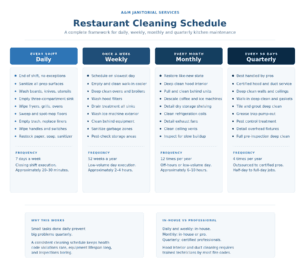
For LA restaurants, a public, visible standard governs cleaning: after each inspection, the Los Angeles County Department of Public Health posts a letter grade (A, B, or C) in the window. The inspection decides that grade, not a cleaning company, but inspectors look at exactly the day-to-day cleanliness that a consistent professional routine keeps in place. That makes professional cleaning one of the clearest ways an operator protects the grade and the trust that comes with it.. Restaurant operators can see how this fits a full program on our Los Angeles restaurant cleaning page.
Front of house
The dining room, entry, host stand, restrooms, and windows are what guests judge first. Front-of-house cleaning covers floors, tables and seating, glass and entry doors, and restrooms kept consistently stocked and sanitized through service. In a city this visual, the entry and windows matter more than operators expect, because they are the first thing a passing diner sees.
Back of house
Kitchens carry the heaviest cleaning load: floors and drains, prep and cooking surfaces, walls, and the grease that builds up everywhere around a line. A&M handles commercial kitchen cleaning and coordinates with licensed specialists for the interior hood and exhaust work that requires dedicated certification, rather than claiming that certification ourselves. You can see the full scope in our restaurant cleaning checklist.
Patios and outdoor dining
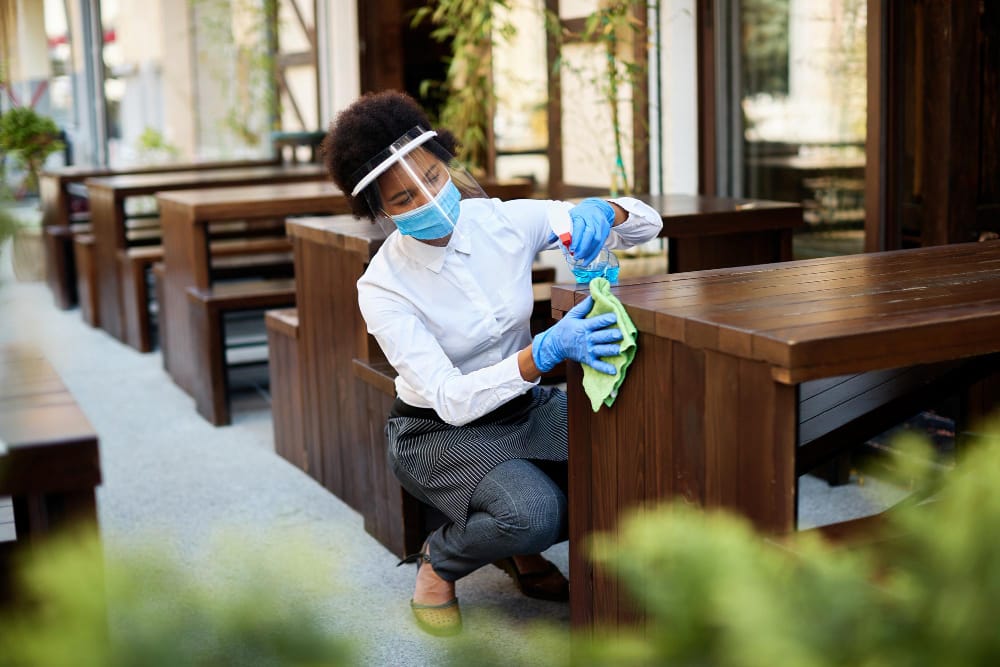
LA’s weather makes patios a year-round revenue space, not a seasonal bonus, which means they need cleaning attention as serious as the indoor dining room. Outdoor furniture, railings, heaters, and the surrounding sidewalk collect street dust and grime quickly, especially when Santa Ana winds are blowing, so patios belong in the regular schedule rather than the occasional deep clean.
Hotel Cleaning in Los Angeles
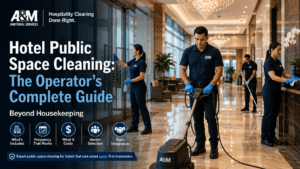
It helps to be precise about what hotel cleaning means here. A&M provides commercial cleaning of a hotel’s public and back-of-house areas. We do not provide guest-room housekeeping, which hotels staff separately. What we keep guest-ready are the spaces between the rooms. See our Los Angeles hotel cleaning page and our broader hotel public space cleaning guide for the full picture.
LA’s hotel landscape is unusually varied: business hotels downtown, beachfront and resort-style properties near Santa Monica and Venice, boutique hotels around Hollywood and West Hollywood, and a dense cluster of airport hotels near LAX. Each draws a demanding guest, and each has its own cleaning quirks. Beachfront properties fight sand and marine-layer humidity in their lobbies and corridors; downtown business hotels turn over conference and event spaces quickly between bookings.
Commercial hotel cleaning covers lobbies and reception areas, public restrooms, elevators and stairwells, corridors, conference and event spaces, fitness rooms, pool decks, and back-of-house. These are high-traffic, high-visibility areas where consistency is what separates a property guests
Tourist-Facing Retail and Storefronts
The third pillar is often overlooked: the shops, boutiques, and galleries that serve both visitors and locals along LA’s retail corridors, from Hollywood and Melrose to Santa Monica’s promenade and the boutiques of the Westside. These stores live and die on first impressions, and the storefront is the first impression. A&M’s retail cleaning keeps these spaces presentable through heavy foot traffic.
Retail cleaning focuses on the surfaces customers actually notice: entryways and glass that face the sidewalk, floors that take a constant stream of foot traffic and tracked-in street dust, fitting rooms, restrooms, and the high-touch points around counters and displays. Sidewalk-facing glass is a particular LA challenge, because traffic film and wind-blown dust dull a storefront fast, and a smudged window reads as a closed or careless shop to someone walking by.
Hospitality Cleaning Across LA’s Districts
Los Angeles is really a collection of distinct hospitality districts, and each one shapes the cleaning brief a little differently:
- Downtown LA. Business hotels, convention and event traffic, and rooftop venues, where the job is often resetting large public and event spaces quickly between bookings.
- Santa Monica, Venice, and the coast. Beachfront hotels and restaurants battle sand, salt air, and marine-layer damp, so entryways, glass, and floors need more frequent attention than inland venues.
- Hollywood and West Hollywood. Boutique hotels, high-profile restaurants, and late-night venues with image-conscious guests, where after-hours service and a spotless front of house are non-negotiable.
- The Westside and luxury retail corridors. High-end boutiques and galleries where storefront glass and polished finishes set the tone, and a single smudged window undercuts the whole presentation.
- The LAX corridor. Airport-area hotels with round-the-clock arrivals and constant lobby and restroom traffic, where consistency at every hour matters more than any single deep clean.
A cleaning plan that works downtown is not the same one that works on the beach, which is why the schedule and scope should be built around the specific venue and where it sits in the city.
Local Factors That Shape an LA Cleaning Plan
A few conditions specific to Los Angeles should shape any hospitality cleaning schedule:
- Year-round operation. The mild climate means little seasonal downtime, so cleaning needs to be consistent all year rather than ramping up for a single peak season.
- Marine layer and coastal humidity. Properties near the coast deal with damp mornings, salt air, and sand, which affect floors, glass, and entry areas.
- Santa Ana winds and dust. Dry, dusty winds coat windows, patios, and storefronts quickly, raising the frequency that exterior-facing surfaces need attention.
- Wildfire smoke and ash. During fire events, fine ash settles on indoor and outdoor surfaces, and venues often need extra cleaning to stay presentable and comfortable for guests.
- Water-conscious methods. In a drought-aware region, efficient, eco-friendly cleaning methods are both expected and practical.
None of these are dealbreakers. They simply mean an LA cleaning plan should be built around local reality rather than copied from a milder, more enclosed market.
Building the Right Cleaning Schedule
The right frequency depends on the venue and its traffic. A busy restaurant or a beachfront hotel lobby usually needs daily service, while a smaller boutique or a quieter back-of-house area may do well with several visits a week. Most LA hospitality venues clean around their operating hours, which means after-hours or early-morning service so guests never see the work. Periodic deep cleans and any specialist services are scheduled into that rhythm rather than bolted on at random.
What to Look for in an LA Hospitality Cleaning Partner
Hospitality is unforgiving, so the right partner matters. Useful things to look for:
- Real experience with hospitality and health-grade environments, not just offices
- Licensed and insured, with consistent, trained crews rather than rotating temporary staff
- Flexible scheduling that works around service hours and event spikes
- Eco-friendly, water-conscious products suited to the region
- Clear communication and accountability when something needs attention
A&M provides commercial cleaning across all three pillars throughout Los Angeles. You can explore the service hub on our Los Angeles service area page, or the industry detail for restaurants and hotels.
Frequently Asked Questions
How often should an LA restaurant be professionally cleaned?
Most full-service Los Angeles restaurants benefit from daily cleaning given high turnover and year-round operation, with periodic deep cleaning layered in. Lower-traffic spots may do well with several visits a week. The right frequency depends on volume, kitchen intensity, and how much outdoor dining the venue runs.
Does professional cleaning affect a restaurant’s LA County health grade?
The letter grade is determined by the official Los Angeles County health inspection, not by a cleaning company. That said, cleanliness is exactly what inspectors evaluate, so a consistent professional cleaning routine is one of the most direct ways an operator supports a strong grade and avoids easily preventable issues.
Do hotel cleaning services include guest-room housekeeping?
No. Commercial hotel cleaning covers public and back-of-house areas such as lobbies, restrooms, corridors, event spaces, and fitness and pool areas. Guest-room housekeeping is a separate function that hotels staff on their own.
Can one company clean restaurants, hotels, and retail?
Yes. Commercial cleaning crews are equipped to handle all three, and using a single partner across a portfolio keeps standards and scheduling consistent. The scope is tailored to each venue type.
How does LA’s climate affect cleaning needs?
Los Angeles brings marine-layer humidity and sand near the coast, Santa Ana winds that coat exterior-facing surfaces with dust, occasional wildfire ash, and year-round outdoor dining. Together these raise how often glass, patios, and entryways need attention compared with a milder, more enclosed climate.
Keep Your LA Venue Guest-Ready
Whether you run a restaurant, manage a hotel, or operate a storefront that greets a steady stream of visitors and locals, the standard in Los Angeles is high and constant. A&M provides commercial cleaning across Los Angeles hospitality, with schedules built around your hours and your space. Contact us for a walkthrough and a plan tailored to your venue.