Running a restaurant means juggling staff, supply chains, customers, and the constant pressure of consistency. Clean kitchens aren’t just about appearances, they’re the operational backbone that keeps inspectors satisfied, equipment running, food safe, and your team productive. This guide breaks down exactly what commercial kitchen cleaning involves, how to schedule it, and when to bring in professional help.
Whether you run a single-location café, a multi-unit franchise, or a high-volume full-service restaurant, the principles are the same: consistent cleaning protects your business, and inconsistent cleaning slowly destroys it.
Why Commercial Kitchen Cleaning Matters
Restaurant owners often treat cleaning as an end-of-shift chore, something to be rushed through so staff can clock out. That mindset costs money. Done right, commercial kitchen cleaning is an investment that pays back in equipment lifespan, inspection scores, employee retention, and customer reviews. Done poorly, it accumulates as small problems that eventually become big ones: a failed inspection, a grease fire, a Yelp review that mentions a smell, a piece of equipment that fails six months early.
Health code and inspections
Every state and municipality has its own health code, and the specifics vary, but the general principles are universal. Inspectors look for food-contact surfaces that are properly sanitized, equipment that’s free of accumulated grease, refrigeration that holds the right temperatures, and pest activity (which is almost always a cleaning issue in disguise). A restaurant that maintains daily and weekly cleaning routines almost never fails an inspection. A restaurant that lets cleaning slip catches up on it the night before and that’s when problems get missed.
Worth noting: health inspectors generally don’t announce visits. The kitchen that passes inspection is the one that’s clean every day, not the one that’s clean once a quarter.
Equipment lifespan and ROI
Commercial kitchen equipment is expensive. A combi oven costs thousands of dollars; a walk-in cooler costs even more; even smaller pieces like fryers and griddles represent real capital. Grease buildup, mineral deposits, and food residue shorten the working life of all of them. Daily cleaning of fryers prevents oil breakdown and extends both equipment and oil life. Weekly cleaning of refrigeration coils keeps compressors from working overtime and burning out. Monthly attention to hood interiors prevents fire hazards that could close your restaurant for days.
Owners who track this notice the pattern: kitchens that prioritize cleaning replace equipment on schedule. Kitchens that don’t replace equipment unexpectedly, at higher cost, often during peak periods.
The Commercial Kitchen Cleaning Schedule
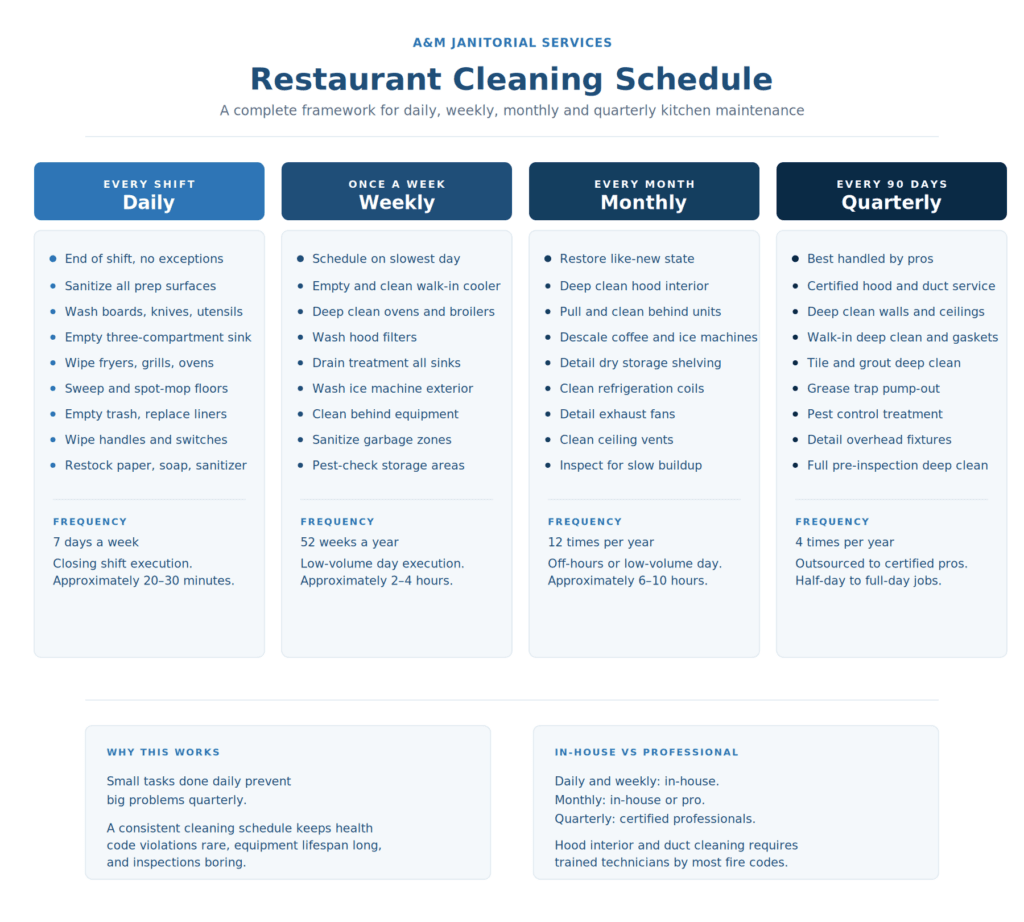
The most effective approach to commercial kitchen cleaning isn’t a giant deep-clean every few weeks it’s small, consistent tasks executed daily, with deeper work layered on weekly, monthly, and quarterly schedules. Here’s how the framework works.
Daily tasks (end of shift)
These tasks happen every single closing shift, no exceptions. The list is intentionally short so it actually gets done.
- Wipe down and sanitize all prep surfaces with food-safe sanitizer
- Clean and sanitize cutting boards, knives, and utensils
- Empty and sanitize the three-compartment sink
- Wipe down the exterior of fryers, grills, and ovens
- Sweep all floors and spot-mop high-traffic areas
- Empty trash and replace liners; take out garbage
- Wipe handles, switches, and high-touch surfaces
- Restock paper goods, soap, and sanitizer for the morning
Weekly tasks
Weekly cleaning catches what the daily routine misses. Schedule these on the slowest day of the week.
- Empty, clean, and reorganize the walk-in cooler and freezer
- Deep clean the inside of ovens, salamanders, and broilers
- Remove and wash all hood filters (most are dishwasher-safe)
- Run drain treatment through floor drains and sinks
- Wash exterior of the ice machine
- Clean behind and underneath cooking equipment where access allows
- Sanitize garbage areas and pest-check storage zones
Monthly tasks
Monthly work is where the kitchen gets visibly different. These tasks restore the kitchen to a like-new state and prevent the slow buildup that accelerates equipment wear.
- Deep clean the interior surface of the exhaust hood (interior, not the duct)
- Pull equipment away from walls and clean behind it
- Descale coffee equipment, ice machines, and dish machines
- Detail-clean shelving in dry storage and walk-ins
- Inspect and clean refrigeration condenser coils
- Detail-clean exhaust fans and ceiling vents (accessible areas)
Quarterly tasks
Some tasks require specialized expertise, time, or equipment that’s beyond the typical kitchen team’s scope. Quarterly is the right cadence for these and they’re typically when professional commercial cleaning services come in.
- Full professional exhaust hood cleaning (interior, ducts, fans)
- Deep clean ceiling tiles, walls, and overhead fixtures
- Detailed walk-in cooler/freezer deep clean and gasket inspection
- Tile and grout deep clean, including under equipment
- Comprehensive grease trap pump-out and cleaning
- Pest control treatment and inspection
Restaurant Deep Cleaning Checklist
A deep clean isn’t a longer daily clean, it’s a fundamentally different process that targets areas that don’t get attention during normal operations. Most restaurants benefit from a full deep clean every 4–6 weeks, scheduled during low-volume periods. Here’s the breakdown by zone.
Cooking equipment
Cooking equipment accumulates carbon, grease, and food residue at a rate that no daily wipe-down can keep up with. Deep cleaning restores efficiency and extends life.
- Fryers: full boil-out with degreaser, replace oil if scheduled, deep clean baskets, scrub the exterior and the area underneath
- Grills and griddles: scrape, season, and degrease the cooking surface; clean the drip trays and the underlying drain
- Ovens (conventional, convection, combi): empty completely, apply oven cleaner per manufacturer instructions, clean racks separately, wipe interior and exterior
- Salamanders and broilers: remove grates, soak in degreaser, scrub and reassemble; address the heat shield
- Steam tables and warmers: drain, descale, sanitize, and inspect heating elements
Prep surfaces and storage
Prep surfaces look fine after a daily wipe, but a deep clean reveals what daily routines leave behind.
- Stainless steel: clean with a stainless cleaner, polish, and treat any rust spots or discoloration
- Walk-in coolers: empty completely, clean shelving with sanitizer, mop floor with hot soapy water, wipe door gaskets, and inspect for any seal damage
- Dry storage: rotate inventory using FIFO (first-in, first-out), wipe all shelving, inspect for pest activity
- Reach-in refrigerators and freezers: same process as walk-ins but more frequent due to higher use
Floors, walls, and drains
Floors and walls take more abuse than most owners realize. They’re also what an inspector notices in the first ten seconds of walking in.
- Floors: apply degreaser, agitate with a stiff brush or floor scrubber, rinse, and squeegee dry
- Grout: scrub with a grout cleaner and brush; consider resealing if it’s been over a year
- Walls: target backsplash areas, wall sections behind equipment, and the lower 4 feet of all walls
- Drains: apply enzyme drain treatment weekly, deep clean the drain covers and trap monthly
- Baseboards and corners: detail with a damp cloth and degreaser. These are the most-skipped areas during normal cleaning
Click here to have a ultimate cleaning checklist for your restaurant!
How to Clean Specific Kitchen Equipment
Equipment-specific cleaning is where most kitchens go wrong, either by skipping steps or by using the wrong products. Here’s what restaurant owners should know about the most consequential pieces.
Cleaning the hood and vent system
[Image: commercial-kitchen-hood-vent-cleaning.webp]
The hood and vent system is the single most important fire-safety asset in a commercial kitchen, and it’s also one of the easiest things to neglect. Here’s how to think about it.
Daily and weekly: kitchen staff can and should wipe the hood exterior, remove and wash hood filters, and keep the immediate area below the hood grease-free. This is normal operational cleaning.
Monthly: interior surfaces of the hood (the underside, the visible interior) can typically be detail-cleaned by a trained kitchen team using appropriate degreasers and PPE.
Quarterly (or as required by your local fire code): the upper interior of the hood, the ductwork, the exhaust fan, and the roof exhaust are typically work for certified hood-cleaning technicians. This isn’t a cost-saving area DIY attempts here are dangerous and can void insurance coverage. Most municipalities require certified hood cleaning by a licensed professional at a defined frequency.
Cleaning fryers safely
Fryers are second only to hoods in terms of fire risk, and they deteriorate fast when neglected. The boil-out is the cornerstone of fryer maintenance.
Drain the fryer completely once the oil has cooled enough to be safely handled, but while the unit is still warm. Fill with water and a fryer boil-out cleaner per manufacturer ratios. Bring to a simmer and let it work for the recommended time, typically 15–30 minutes. Drain again, scrub interior surfaces with a non-abrasive pad, rinse thoroughly with clean water (multiple rinses), and dry completely before refilling. Oil that’s used in a freshly boiled-out fryer lasts noticeably longer.
Baskets should soak in degreaser between deep cleans and be inspected for damage. A damaged basket means uneven cooking and increased oil contamination.
Sanitizing food-contact surfaces
The three-step process for food-contact surfaces is the foundation of food-safety compliance. Cleaning is not the same as sanitizing they’re two separate actions.
- Step 1: Clean the surface with detergent and water to remove all visible soil
- Step 2: Rinse with clean water to remove the detergent
- Step 3: Apply EPA-registered sanitizer at the proper concentration; let it stand for the contact time on the label, then either air-dry or wipe with a clean, sanitizer-soaked cloth
Sanitizer concentrations matter. Too low means it’s not effective. Too high means it can leave residue or damage equipment. Test strips are inexpensive every kitchen should use them.
DIY vs Professional Commercial Cleaning
Not every cleaning task needs a professional, and not every kitchen needs the same level of professional support. Here’s a framework for deciding what to handle in-house and what to outsource.
When in-house cleaning works
In-house cleaning is a great fit for smaller operations and for the daily and weekly tiers of the schedule. If your team has the time and discipline to execute consistently, the daily and weekly checklists are straightforward and don’t require specialized equipment.
In-house cleaning also makes sense during slower seasons, when staff have time and the kitchen isn’t generating enough buildup to justify outside help.
- Single-location operations with consistent staff
- Daily and weekly task tiers
- Restaurants with strong morning prep teams who can deep-clean before service
- Small-format kitchens where everything is within easy reach
When to hire commercial cleaners
Professional commercial cleaning becomes the smarter option in several scenarios.
- Multi-location operations where consistency across sites matters
- High-volume kitchens where in-house teams don’t have time for monthly and quarterly tasks
- Exhaust hood interior and duct cleaning (almost always best handled by certified technicians)
- Quarterly deep cleans that require specialized equipment or chemicals
- Post-renovation cleanup or pre-inspection deep cleans
- When kitchen team turnover makes in-house cleaning quality unpredictable
A professional commercial cleaning company can also bring a level of objectivity that in-house staff struggle to maintain they notice what the team has stopped seeing. That second pair of eyes catches problems before they become inspection issues.
Commercial Kitchen Cleaning FAQ
How often should a restaurant kitchen be deep cleaned?
Most commercial kitchens benefit from monthly deep cleans of major equipment and surfaces, with daily and weekly maintenance in between. High-volume kitchens may need more frequent deep cleans, while smaller operations can stretch to every six weeks depending on use.
What’s the difference between cleaning and sanitizing in a commercial kitchen?
Cleaning removes visible dirt and food residue from surfaces. Sanitizing reduces microorganisms to safe levels on food-contact surfaces. Both steps are required by most health codes you can’t sanitize a dirty surface effectively.
Can restaurant owners clean their own hood vents?
Routine wiping of hood exteriors and washing removable filters is typically appropriate for in-house staff. However, the interior of the exhaust hood, ductwork, and exhaust fan generally require trained technicians due to fire safety considerations and access requirements.
How much does commercial kitchen cleaning cost?
Pricing varies significantly by kitchen size, equipment, frequency, and location. A small café might invest a few hundred dollars per month in professional cleaning, while a busy full-service restaurant could spend several thousand. Most providers offer custom quotes based on a site walkthrough.
What chemicals are safe for cleaning a commercial kitchen?
Food-safe degreasers, EPA-registered sanitizers, and stainless steel cleaners designed for commercial use are standard. Always check that products are approved for food-contact surfaces where applicable, and follow manufacturer dilution instructions carefully.
Get Professional Restaurant Cleaning in Your City
[Image: professional-restaurant-cleaning-team.webp]
A&M Janitorial Services provides professional restaurant cleaning across nine U.S. cities, including Seattle, Los Angeles, Portland, Miami, and more. Our teams handle the deep cleaning, the equipment maintenance, and the quarterly tasks that keep your kitchen safe, code-compliant, and operationally smooth without taking time away from your team.
Whether you’re managing a single restaurant or a multi-location operation, we offer customized cleaning schedules built around your hours, your equipment, and your specific needs. Contact us for a walkthrough and a custom quote tailored to your kitchen.
Schedule a free quote for your restaurant cleaning needs today.