Commercial carpet is a significant investment that protects floors, absorbs sound, and shapes how a space looks and feels. It’s also one of the hardest-working surfaces in any building absorbing foot traffic, food, coffee spills, ink, dirt, and every variety of debris a commercial environment can produce. The difference between carpet that lasts five years and carpet that lasts fifteen comes down almost entirely to maintenance: how it’s cleaned routinely, how it’s deep cleaned periodically, and how spots and stains are handled when they happen.
This guide walks through the three pillars of commercial carpet care routine maintenance, professional deep cleaning, and stain removal with the practical detail facility managers and business owners need to extend carpet lifespan and protect appearance.
Why Commercial Carpet Care Matters
Carpet replacement is expensive. For a medium-sized office, replacing carpet across the entire space can run into tens of thousands of dollars in materials and installation, plus the cost of business disruption while the work happens. Most of that expense is avoidable. The vast majority of carpets that need early replacement aren’t failing because they wore out they’re failing because they were never cleaned properly.
Beyond pure cost, commercial carpet condition affects more than facility managers often realize:
- First impressions: dirty or stained carpet immediately signals lack of maintenance, undermining brand impressions for both customers and prospective employees
- Indoor air quality: carpets trap allergens, dust, and particulate matter; without proper cleaning, they release that material back into the air
- Employee health and comfort: poorly maintained carpet contributes to respiratory issues and allergies in office environments
- Insurance and liability: damaged or improperly maintained flooring can be a slip-and-fall liability
- Property value: clean, well-maintained commercial spaces command better lease and sale values
Routine Carpet Maintenance
The foundation of commercial carpet care is consistent routine maintenance the daily and weekly work that prevents soil from being ground into fibers in the first place. Most carpets fail because routine work was skipped, not because deep cleaning was missed.
Daily vacuuming, done right
Vacuuming is more important than most facility managers think. The dirt and grit that gets tracked into a building cuts carpet fibers like microscopic knives every time someone walks on it. Removing that grit before it gets ground in is what preserves the carpet’s appearance and lifespan.
- High-traffic areas need vacuuming daily entries, hallways, common areas, near elevators
- Medium-traffic areas (open offices, meeting rooms): three to five times per week
- Low-traffic areas (private offices, storage): once or twice per week minimum
- Use a commercial-grade vacuum with HEPA filtration; residential vacuums lack the suction power and filtration capacity for commercial environments
- Slow, overlapping passes outperform fast passes the slower the vacuum moves, the more it actually removes
- Replace bags and filters per the manufacturer schedule; a full bag drops suction dramatically
Entry mat strategy
Most of the dirt in a commercial space comes in on shoes. An effective entry mat system stops up to 80% of that dirt before it ever reaches the main carpet. This is the single highest-ROI investment a facility manager can make in carpet care.
- Outdoor scraper mats catch large debris and moisture
- Indoor entry mats (10-15 feet of walk-off space) capture remaining fine dirt
- Replace or professionally clean entry mats on a regular schedule saturated mats stop working
- Consider mat rentals with weekly rotation for high-traffic entries
Spot treatment within 24 hours
The single most important rule of carpet care: treat spots within 24 hours. After 24 hours, most spills oxidize and bond chemically with carpet fibers, turning from “spot” (removable) into “stain” (much harder to remove). A simple spot-treatment protocol for staff catches problems early.
- Have a spot-treatment caddy in every department with absorbent cloths, neutral spot remover, and a spray bottle of clean water
- Train staff to report and address spots immediately most are 5-minute jobs if caught fast
- Stain protocol below covers the specific techniques
Professional Carpet Cleaning Methods
Routine maintenance keeps carpet looking acceptable. Professional deep cleaning is what restores it. Most commercial carpets need professional cleaning every 3 to 12 months depending on traffic, with several distinct methods used depending on carpet type and condition.
Hot water extraction (steam cleaning)
Hot water extraction often called steam cleaning is the most thorough commercial carpet cleaning method and what most manufacturers recommend. A solution of hot water and cleaning agent is forced into carpet fibers under pressure, then immediately extracted along with embedded soil. Done correctly, it deep cleans without leaving residue that attracts new dirt.
- Best for: most commercial carpet types including cut pile and loop pile
- Typical cleaning cycle: every 6-12 months for medium traffic; every 3-6 months for high traffic
- Drying time: typically several hours when done by professionals with high-extraction equipment
- Note: this is a different process from drying water-damaged carpet for that situation, see our guide on how to dry wet carpet fast
Encapsulation cleaning
Encapsulation uses a polymer-based solution that crystallizes around dirt particles, which are then vacuumed away. It’s a low-moisture method that allows carpet to be used quickly after cleaning, making it popular for businesses that can’t close for extended drying.
- Best for: high-traffic commercial environments needing fast turnaround
- Typical cycle: more frequent (monthly or quarterly) as interim maintenance between deeper cleans
- Quick turnaround: carpet is usable within 20-30 minutes after cleaning
- Limitation: not a replacement for periodic hot water extraction
Bonnet cleaning
Bonnet cleaning uses a rotating absorbent pad on the surface of the carpet, lifting surface dirt with minimal moisture. It’s fast and inexpensive but only cleans the top layer of carpet deeper embedded soil remains.
- Best for: routine surface maintenance in low-pile commercial carpet
- Typical cycle: between deep cleans, as appearance maintenance
- Limitation: doesn’t address deep soiling; over-reliance can lead to soil buildup at the base of fibers
Choosing the right method
Most commercial properties benefit from a layered approach: daily vacuuming, monthly or quarterly encapsulation or bonnet cleaning for appearance, and annual hot water extraction for deep restoration. Professional cleaners assess carpet condition and recommend the right combination for each space.
Commercial Carpet Stain Removal
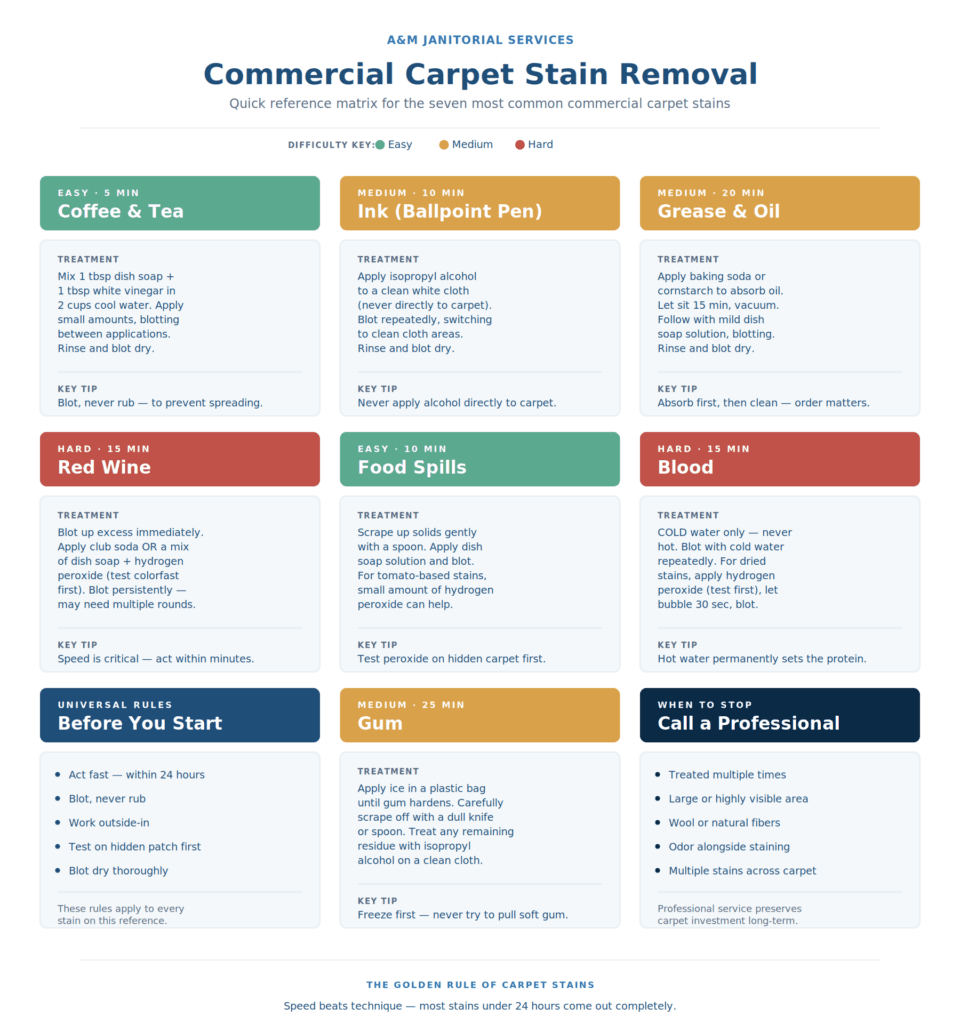
Stains are inevitable in commercial spaces. The difference between a stain that comes out completely and one that becomes permanent is technique, timing, and knowing which products to use on which spills.
The five universal stain removal rules
Before any specific stain technique, these rules apply to all carpet stain situations:
- Act fast within 24 hours, ideally within 1 hour
- Blot, never rub rubbing pushes the spill deeper into fibers and spreads it outward
- Work from the outside of the spill toward the center to prevent spreading
- Always test cleaning solutions on a hidden patch of carpet first
- Blot dry thoroughly when finished residual moisture leads to wicking (stain reappearing as it dries)
Common commercial carpet stains and treatments
Coffee and tea: blot up excess immediately. Mix one tablespoon dish soap with one tablespoon white vinegar in two cups of cool water. Apply small amounts to the stain, blotting between applications. Rinse with clean water and blot dry.
Ink (ballpoint pen): apply isopropyl alcohol to a clean white cloth (never directly to carpet). Blot the stain repeatedly with the alcohol-soaked cloth, transferring ink from carpet to cloth. Switch to a clean area of the cloth as needed. Rinse with cool water and blot dry.
Grease and oil: apply baking soda or cornstarch to absorb the oil, let it sit for 15 minutes, then vacuum. Follow with a mild dish soap solution, blotting carefully. Rinse and blot dry.
Red wine: blot up excess immediately. Apply club soda or a mixture of dish soap and hydrogen peroxide (test for colorfastness first). Blot persistently, red wine can require multiple treatments.
Food spills (sauces, soups): scrape up solids gently with a spoon. Apply a dish soap solution and blot. For tomato-based stains, a small amount of hydrogen peroxide can help after testing for colorfastness.
Blood: cold water only, never hot, which sets the protein in blood permanently. Blot with cold water repeatedly. For dried stains, apply hydrogen peroxide directly (test first), let it bubble for 30 seconds, then blot.
Gum: apply ice in a plastic bag until gum hardens, then carefully scrape off with a dull knife. Treat any remaining residue with isopropyl alcohol.
When to stop and call a professional
Some situations warrant calling a commercial carpet professional rather than continuing to attempt removal:
- The stain has been treated multiple times and isn’t improving
- The stain covers a large area or is in a highly visible location
- The carpet has special care requirements (wool, natural fibers, anti-static treatment)
- There are odor issues alongside the visible staining
- Multiple stains across the carpet suggest a deeper cleaning is needed regardless
When to Call Professional Commercial Carpet Cleaners
Even the best in-house maintenance program needs professional commercial carpet cleaning periodically. The right cadence depends on traffic, building type, and carpet specifications, but most commercial spaces benefit from professional cleaning at least once a year, with high-traffic environments needing it quarterly.
Signs it’s time to schedule a professional cleaning:
- Traffic lanes are visibly darker than the surrounding carpet
- It’s been more than 12 months since the last deep clean
- The carpet has lost its texture or feels matted
- There’s a musty or stale smell that vacuuming doesn’t resolve
- Multiple stains from different incidents need attention
- Manufacturer warranty requires professional cleaning at a defined frequency
A&M Janitorial Services provides commercial carpet cleaning across nine U.S. cities including Seattle, Los Angeles, Portland, and Miami. Our teams handle routine maintenance, deep cleaning rotations, and emergency stain removal with cleaning methods matched to your carpet type and traffic level.
Commercial Carpet Care Across Our Service Areas
Miami: Miami’s hospitality industry deals with a carpet care challenge that most other cities never encounter: relative humidity that consistently sits between 70% and 85% year-round. That ambient moisture slows drying times after professional cleaning, increases the risk of wicking (where stains return to the surface as carpet dries), and creates conditions where mildew can take hold in carpet padding. Beachfront and waterfront properties have an additional concern salt residue tracked in by guests, which over time crystallizes in carpet fibers and accelerates wear. For these reasons, commercial cleaning in Miami typically requires more frequent encapsulation cleaning between deep extractions, lower-moisture methods when possible, and faster turnaround on spot treatment than carpets in drier climates need.
Portland: Portland averages over 150 days of measurable rain per year, and that hydrological reality shapes every aspect of commercial carpet care in the city. Restaurants in neighborhoods like the Pearl District, Mississippi Avenue, and Hawthorne see steady foot traffic from regular customers who arrive with wet shoes for much of the year, and the fine grit from Portland’s older streets that comes in with them is exactly the type of abrasive that destroys carpet fibers fastest. Effective carpet maintenance for Portland restaurants starts with aggressive entry mat protocols and increases vacuuming frequency during wet months, with deeper cleaning rotations timed for the small windows of consistently dry weather.
Los Angeles: Los Angeles presents an opposite set of conditions: low humidity, persistent airborne dust, and occasional smog events that deposit fine particulate matter on every horizontal surface including carpets. LA’s hospitality and dining spaces also tend toward higher-end finishes, with hotels in West Hollywood, Beverly Hills, and Downtown LA often featuring natural fiber rugs and wool blends that require specialized care methods very different from the synthetic carpet most commercial spaces use. Combine that with the city’s extreme tourism volume and high turnover in restaurant traffic, and the result is that restaurant carpet cleaning in Los Angeles almost always benefits from professional rotations more frequent than industry-standard intervals would suggest.
Schedule a free quote for your commercial carpet cleaning needs today.